
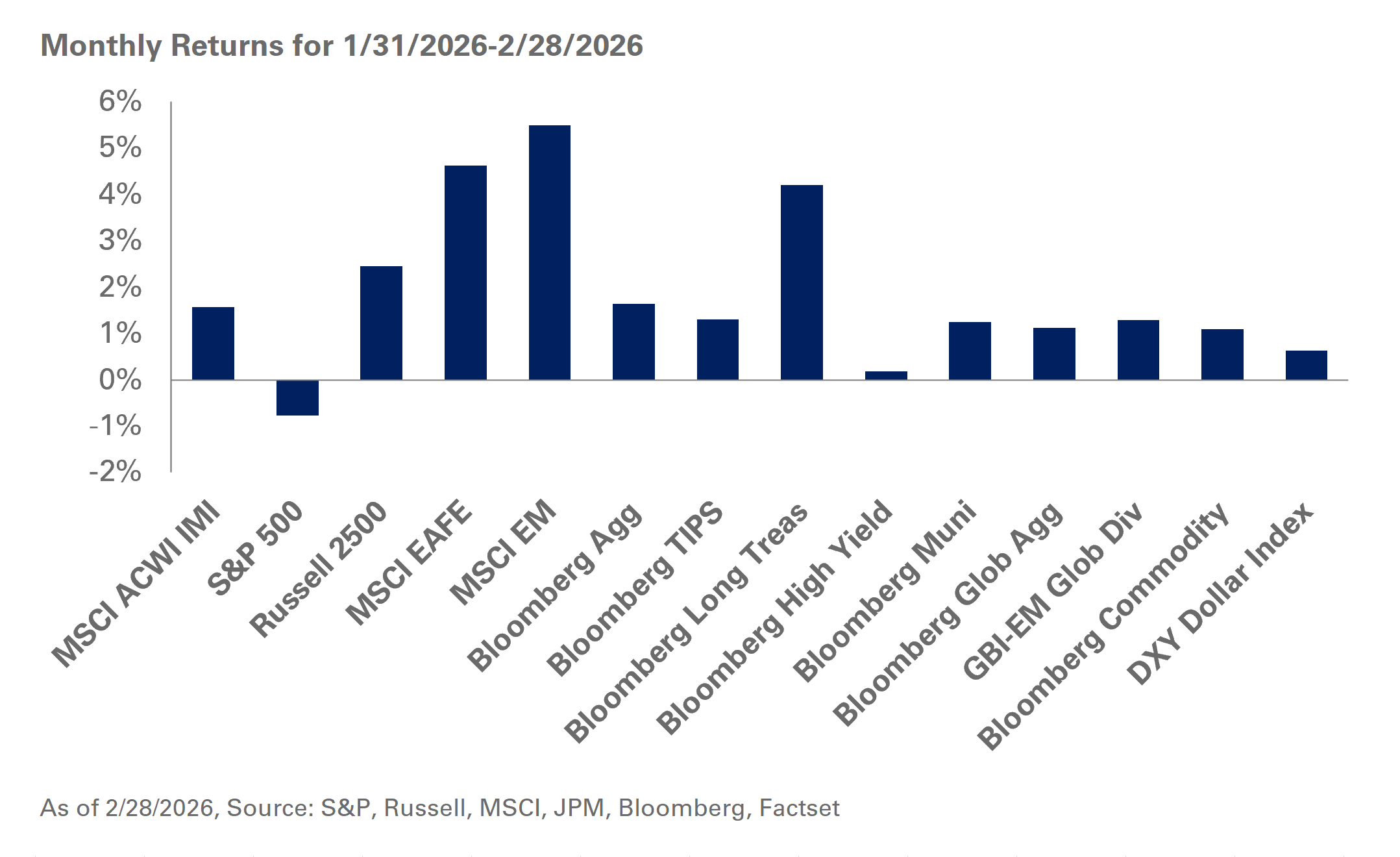
In February 2026, market trends showed a notable shift as investors distanced themselves from U.S. mega-cap technology stocks, resulting in a 0.9% decline in the S&P 500. This change was mirrored by gains in U.S. value, small-cap equities, and international stocks, highlighting a preference for diversity over concentration among investors. As one NEPC analyst remarked, "the market reaction was muted as the broader index outperformed relative to the top 10 names."
Investors are increasingly exploring the impact of artificial intelligence on established sectors beyond its infrastructure developments. The evolving technology landscape is challenging traditional business models and prompting a reevaluation of investment strategies.
On the economic front, February's data painted a complex picture. The Consumer Price Index (CPI) for January decelerated to 2.5% year-over-year, while the January core Producer Price Index (PPI) saw a month-over-month rise of 0.8%. This indicates that inflation pressures from producers are beginning to exceed expectations. The government shutdown and declining exports played a role in the fourth quarter's real GDP of only 1.4%, as consumer spending and business investment showed resilience amidst these challenges.

In the fixed-income market, the Bloomberg U.S. Aggregate Bond Index recorded gains, boosted by a noticeable rally in interest rates. Yields on 10-year Treasuries fell to 4.04%, marking their lowest levels in months due to heightened demand for safe-haven assets. Despite these positive developments, credit spreads widened, and leveraged loans suffered from a dip in market sentiment.
February brought significant uncertainty to the macroeconomic landscape, primarily driven by two critical events. The first was a Supreme Court ruling that declared tariffs imposed under the International Emergency Economic Powers Act (IEEPA) unconstitutional. This ruling could lead to refunds for revenues generated by these tariffs, prompting a quick response from the administration, which reinstated a 10% baseline tariff under Section 122 of the Trade Act of 1974.
Additionally, international tensions escalated with coordinated airstrikes carried out by the U.S. and Israel against Iran on February 28. As a consequence, oil prices surged, and global capital markets reacted swiftly. NEPC analysts noted, “Iran has a limited impact on the global economy and investor portfolios,” with oil exports reportedly under 2 million barrels per day, and most of those sales going unofficially to China. The analysts affirmed that "there appears to be sufficient spare capacity of oil that can be sourced globally from the Middle East and other parts of the world," which could help mitigate potential supply shocks.
Yet, the potential for increased volatility arises from the question of how Iran might respond, with markets on alert for any significant threats aimed at Middle Eastern oil facilities or potential blockades of vital trade routes such as the Strait of Hormuz. Investors are advised to remain vigilant, as the situation could create rebalancing opportunities in global equities following any substantial market drawdowns.
In light of these unpredictable circumstances, NEPC recommends that investors adhere to their long-term strategic asset allocation goals. It’s crucial to maintain a healthy exposure to equities while also seeking rebalancing opportunities as market conditions fluctuate. The analysts advised, "balancing exposure of the earnings power from the largest S&P 500 names with value and quality companies across the globe" is essential.
Moreover, investors should keep an eye on their equity positions and be cautious of high tracking errors associated with the leading 10 companies in the MSCI ACWI Investable Market Index (IMI). Maintaining high-quality, liquid assets is recommended, with a cautionary stance on non-investment-grade public debt. Holding appropriate safe-haven fixed-income investments is also emphasized for ensuring liquidity and protecting against possible market downturns.
With February's insights in mind, the investment landscape remains complex and dynamic, urging investors to remain disciplined and forward-thinking as they navigate the challenges ahead.